
Builder Floor Interiors in South Delhi: Cost, Layouts and What to Fix First
What a builder floor interior costs in South Delhi, from about ₹700 per sq ft for a refresh to ₹5,000+ for a full strip of an older floor, why the middle of these plans goes dark, and the order to fix things in: water, power, plumbing, windows, then joinery.
16 November 2026
A builder floor interior in South Delhi typically costs about ₹700 to ₹1,500 per sq ft for a refresh of a new floor, ₹1,500 to ₹3,500 for a full interior, and ₹2,500 to ₹5,000 or more for a full strip and rebuild of an older floor. Before any of that money goes into wardrobes and panelling, fix the things behind the walls first: water, power, plumbing and windows.
Builder floors are how much of South Delhi lives now. An old bungalow on a 200 to 500 sq yd plot in Greater Kailash, Defence Colony, Panchsheel, Safdarjung Enclave or New Friends Colony is rebuilt as stilt parking with three or four floors above, and each floor is sold as a separate home. That shape brings its own problems, and its own order of work. This guide goes through cost, the usual layout, and what to fix first.
What a builder floor interior costs
The biggest question is not the area. It is how much of the builder’s work you keep. A new floor usually comes with marble or tile flooring, a basic kitchen, finished bathrooms and sometimes wardrobes. An older floor, 15 years or more, usually needs most of that redone.
These are market ranges, per sq ft of floor area, excluding appliances, ACs, loose furniture and GST:
| Scope | Typical range per sq ft | What it usually covers |
|---|---|---|
| Refresh of a new builder floor | ₹700 – ₹1,500 | Wardrobes, TV and storage units, ceiling and lighting changes, paint, some panelling. Floors, kitchen and bathrooms kept |
| Full interior on a new builder floor | ₹1,500 – ₹3,500 | All of the above, plus a new kitchen, feature walls, full false ceiling, upgraded doors and hardware, some flooring changes |
| Full strip of an older floor | ₹2,500 – ₹5,000+ | New wiring and plumbing, waterproofing, new floors and bathrooms, all carpentry, ceilings and finishes |
For a floor of about 2,000 sq ft, that works out to roughly:
- Refresh: ₹14 – 30 lakh
- Full interior on a new floor: ₹30 – 70 lakh
- Full strip of an older floor: ₹50 lakh to over ₹1 crore
Published figures sit close to these, though they spread widely. NoBroker’s interior cost guide gives ₹1,200 to ₹1,600 per sq ft for basic finishes, ₹1,700 to ₹2,500 mid-range, ₹2,600 to ₹4,000 premium and ₹4,100 to ₹6,000+ for luxury, and Livspace’s Gurgaon page gives ₹800 to ₹1,500 budget, ₹1,500 to ₹2,500 mid-range and ₹2,500 to ₹4,500 premium. For renovation, NoBroker gives ₹1,000 to ₹2,000 per sq ft in Delhi and IIFL’s renovation guide ₹2,200 to ₹4,000 in Delhi NCR. Studio Matrx’s builder floor guide puts an entry-level fit-out of a 1,800 to 2,400 sq ft floor at ₹18 to 30 lakh. Our upper band sits at the top of these because it includes veneer, imported stone and new services throughout. These are indicative ranges; a site visit gives the real figure for your floor.
Where you land inside each band depends on materials: laminate or veneer, Indian or imported marble, standard or premium hardware. Our interior design cost per sq ft guide breaks that down item by item, and the modular kitchen cost calculator prices the kitchen on its own.
A few items show up on builder floor budgets more than on apartment budgets. Rough market ranges:
- Rewiring an older floor (new conduits, wires, distribution board, modular switches): about ₹120 – ₹300 per sq ft of floor. Published figures vary with scope: Construction Estimator India gives ₹120 to ₹200 for mid-range wiring in Delhi NCR, plus 20 to 30 percent when old walls have to be chased, and ₹180 to ₹300+ with premium brands.
- Redoing a bathroom (waterproofing, tiles or stone, sanitaryware, fittings): about ₹2.5 – 6 lakh each, more with imported fittings or stone. HomeLane puts a full remodel at ₹2.5 to 6 lakh or more, and HouseYog a premium one at ₹2.5 to 5 lakh or more.
- Terrace waterproofing on a top floor: about ₹70 – ₹180 per sq ft, depending on the system, and more if old mud and brick layers have to come off first.
Check the builder’s work before you decide what to keep
On a new floor, open the kitchen and wardrobe shutters and look at the edges. Many builder kitchens and wardrobes are made of particle board or plain MDF with basic hinges and channels. They look fine on handover day, then swell near the sink and sag within a few years. If the carcass is poor, replace it. If it is good plywood or HDHMR (we compare the two in HDHMR vs BWP plywood), new shutters and hardware can be enough.
Flooring is usually worth keeping on a new floor, especially marble. Bathrooms are worth a water test (see below) before you decide.
The usual layout, and why the middle is dark
Most builder floors in South Delhi follow a similar plan. The plots are deep and narrow, and the side walls are often shared with, or very close to, the next building. So the floor gets light and air only from the front and the back, plus a small shaft or two in the middle.
That gives a familiar layout:
- a drawing room at the front, often with a balcony over the road;
- a dining area and passage in the middle, next to the lift and stairs;
- a kitchen in the middle or at the back, often on a shaft;
- bedrooms at the front and back, each with an attached bathroom;
- sometimes a small staff room near the kitchen and a puja space off the dining area.
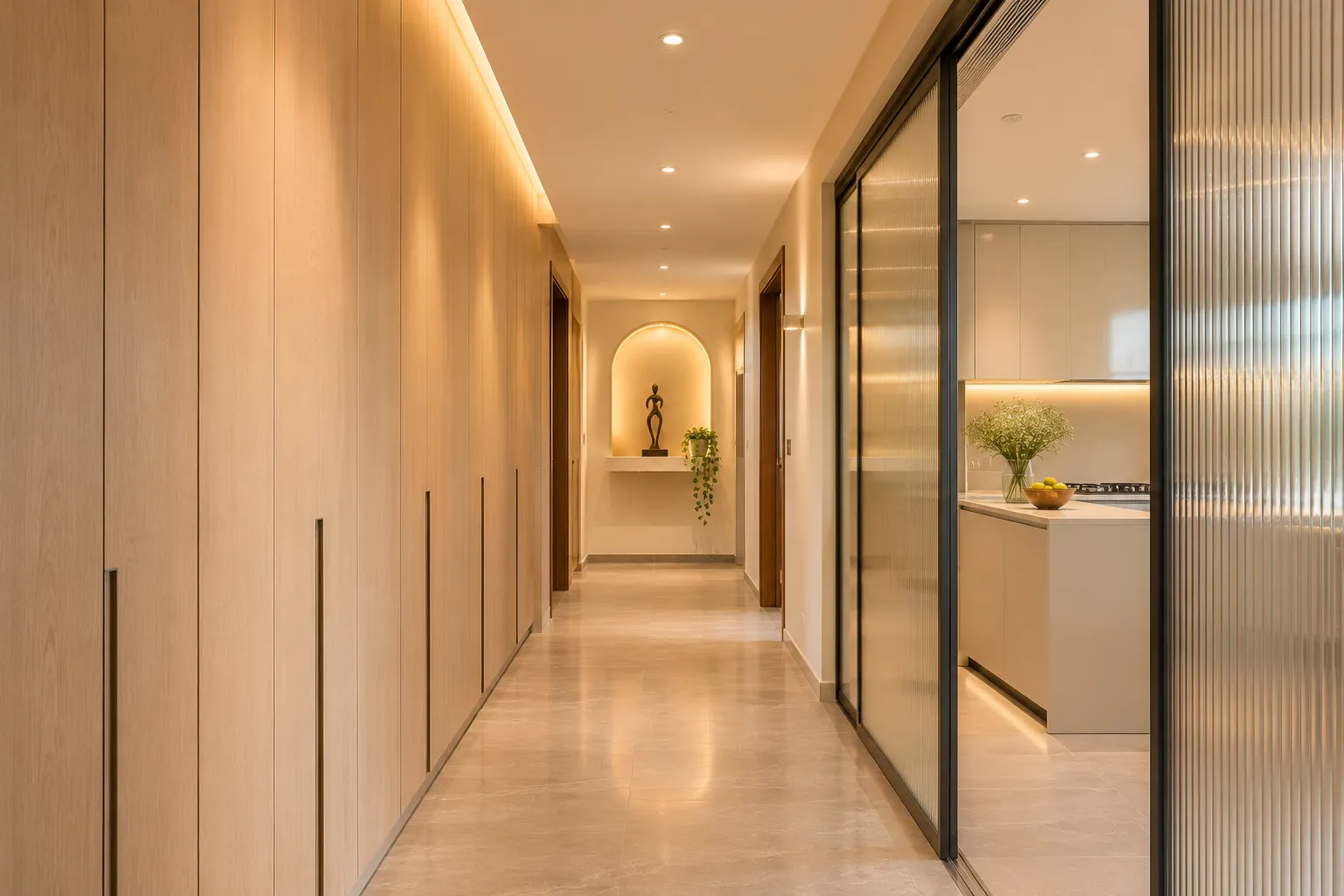
The weak spot is the middle. The dining area and passage can be dark at noon. A few things help:
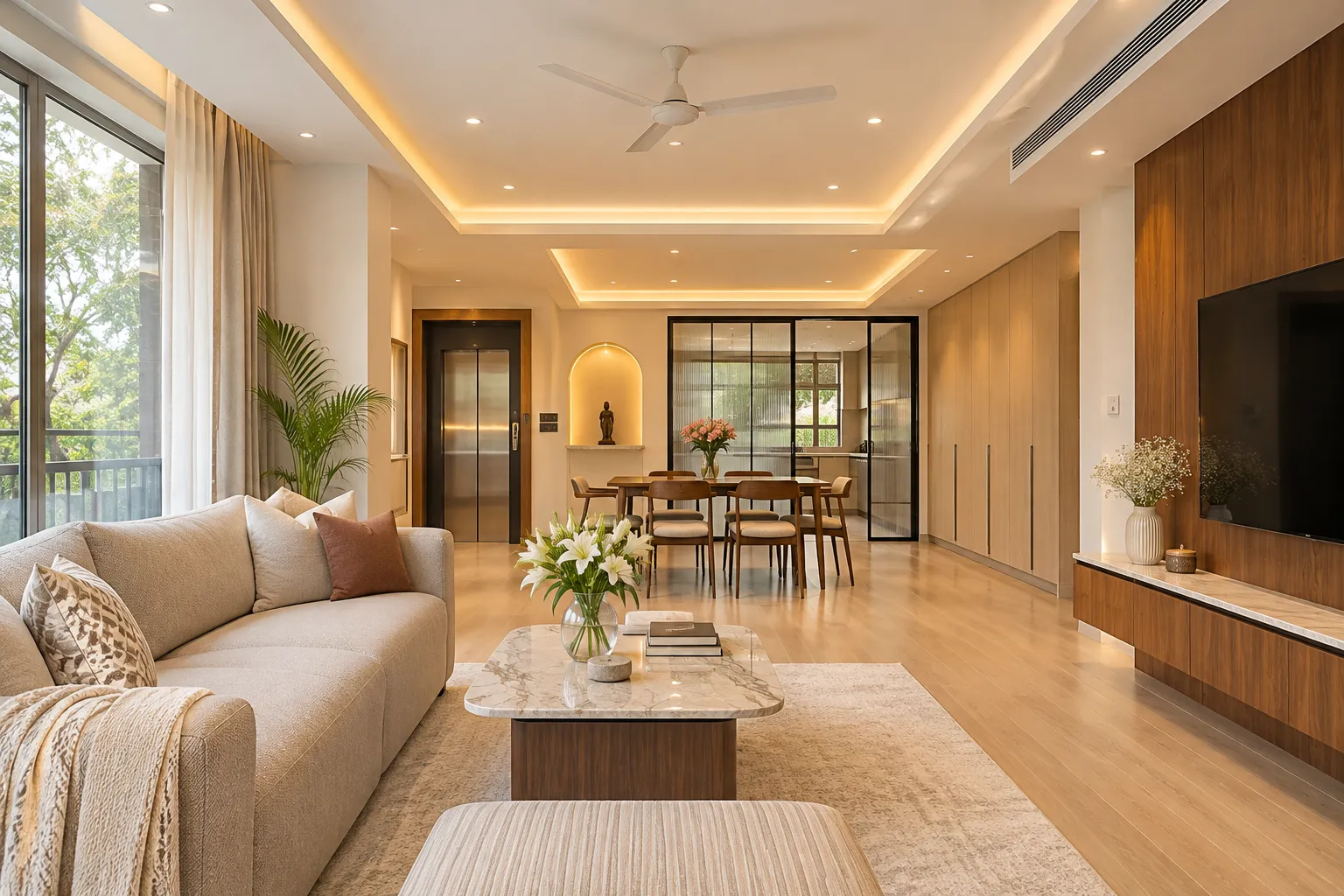
- Open the kitchen to the dining area with a glass partition or a wide sliding door, so the kitchen’s shaft light reaches the middle.
- Keep the middle light in colour. Light floors, light walls and pale wood finishes there. Save the dark veneers and stone for the front rooms that get daylight.
- Light the middle properly. Cove lighting, wall washers and a lit niche or art wall make a passage feel like a room. Our false ceiling vs cove lighting post explains the options.
- Turn the long passage into storage. A full-height shallow cupboard wall, 300 to 400 mm deep, along a corridor often holds more than a spare room.
What to fix first
The order matters more on a builder floor than in a society apartment, because you share walls, slabs, tanks and a staircase with other owners. Fix things behind the walls before you spend on things in front of them.
1. Water: seepage, bathrooms and the terrace
Seepage is the most common complaint in builder floors, and the most expensive one to fix after the panelling is up. Check:
- the walls and ceilings below and next to every bathroom, for damp patches, peeling paint or white salt marks;
- the ceiling under the floor above’s bathrooms, if you are not on the top floor;
- the terrace, if you are on the top floor. Top floors also get hot, so ask about roof insulation along with waterproofing;
- outside walls facing the rain, especially around windows.
A simple moisture meter reading on a dry day tells you a lot. If a bathroom shows damp, redo its waterproofing before you tile over it or panel the wall behind it.
2. Electrical load and the distribution board
Builder floors are often wired for fewer ACs and appliances than a family now runs. Check the sanctioned load on the electricity bill, the size of the distribution board, and whether every room has a proper AC point. Plan for:
- an AC point in every bedroom, the drawing room and the dining area;
- separate circuits for the kitchen, geysers and ACs;
- inverter or backup wiring for lights, fans and the fridge;
- an EV charging point in the stilt parking, if your building allows it.
Do this now. Adding a circuit after the wardrobes and ceiling are in means breaking them.
3. Plumbing and water pressure
Water tanks are often shared, and the upper floors can get weak pressure. A small pressure pump fixes most of it, but it needs a power point and a place to sit. Also check geyser points in every bathroom, the slope of the kitchen drain, and where the water purifier and washing machine will go.
4. Windows, dust and noise
The front rooms usually face a road, and South Delhi winters bring heavy pollution. Good windows (well-sealed aluminium or uPVC, double glazed if the road is busy) cut dust, noise and AC load. They are best done before the curtains, pelmets and ceiling.
5. Only then: ceilings, carpentry and finishes
With water, power, plumbing and windows sorted, the rest goes in the normal order: false ceiling, then flooring changes, then carpentry, then paint and finishes. Because we make the carpentry in our own workshop, wardrobes and kitchens can be built while the site work goes on, which saves weeks.
Shared building rules
A builder floor is a home, but the building is shared. Before work starts, sort out:
- The other owners or the building association: work hours, Sunday rules, and who to call if something goes wrong.
- The lift and staircase: protect the lift cabin and stair edges, and agree how debris goes down and when it is taken away.
- Material deliveries: many South Delhi lanes are narrow and parked on both sides, so plan delivery times.
- Anything structural: don’t break a wall, cut a beam or enclose a balcony without a structural engineer and a check of the sanctioned plan. Purely internal, non-structural work is much simpler.
Winter work and GRAP
From November to January, Delhi’s pollution plan (GRAP) can stop dusty work at its higher stages: demolition, breaking walls, cutting stone and similar. In recent winters, non-dusty work such as carpentry, plumbing, electrical work and interior decoration has generally been allowed to continue, but painting, polishing and varnishing have been stopped at Stage III. The rules change each year, so check the current CAQM order. If your project needs heavy breaking, try to finish it before November or plan it after January, and keep carpentry, electrical and plumbing work for the winter.
How long it takes
- Refresh of a new floor: about 6 – 10 weeks.
- Full interior on a new floor: about 3 – 4 months.
- Full strip of an older floor: about 4 – 6 months.
Add time for building work-hour rules, approvals for anything structural, and any GRAP stoppage. Before you sign, our turnkey contract checklist lists what the contract should say about the timeline and what can fairly extend it.
Our work on South Delhi floors
We work on builder floors and older houses across South Delhi, from Friends Colony and New Friends Colony to Anand Niketan. Our Friends Colony duplex and Anand Niketan residence show finished work.
We take these jobs as a single turnkey contract: survey, design, site work and carpentry made in our own workshop. If you have a builder floor, new or old, book a site visit. We will check the water, power and plumbing first and give you a range for your floor before any design starts.
Frequently asked
Common questions
How much does a builder floor interior cost in South Delhi? +
At typical market rates, a refresh of a new builder floor (keeping the floors, kitchen and bathrooms) runs about ₹700 to ₹1,500 per sq ft, a full interior on a new floor about ₹1,500 to ₹3,500, and a full strip and rebuild of an older floor about ₹2,500 to ₹5,000 or more. For a 2,000 sq ft floor that is roughly ₹14 to 30 lakh, ₹30 to 70 lakh and ₹50 lakh to over ₹1 crore. Materials decide where you land.
What should I check first in a builder floor before doing interiors? +
Water first: seepage, bathroom waterproofing and, on the top floor, the terrace. Then the electrical load and distribution board, then plumbing and water pressure, then the windows. Only after these are sorted should money go into wardrobes, panelling and finishes.
Should I redo the builder's kitchen and wardrobes in a new builder floor? +
Look inside before deciding. Many builder kitchens and wardrobes use particle board or basic MDF with plain hardware, which swells near water and sags over time. If the carcass is poor, replace it. If it is good plywood or HDHMR, a change of shutters and hardware can be enough.
How long do builder floor interiors take? +
Roughly 6 to 10 weeks for a refresh, 3 to 4 months for a full interior on a new floor, and 4 to 6 months for a full strip of an older floor. Building rules on work hours, and winter pollution curbs on dusty work, can add time.
Can interior work continue during GRAP pollution restrictions in Delhi? +
Dusty work such as demolition, breaking walls and cutting stone is usually stopped under the higher GRAP stages. In recent winters, non-dusty work like carpentry, plumbing, electrical work and interior decoration has generally been allowed, but painting, polishing and varnishing have not. Check the current CAQM order, and plan the dusty work outside November to January where you can.