
Laminate, Acrylic, PU or Veneer? How to Choose the Finish for Your Kitchen and Wardrobes
What each furniture finish looks like, how it wears in an Indian home, what it costs per sq ft and per running foot, and what cold press and hot press actually mean on a quotation.
26 October 2026
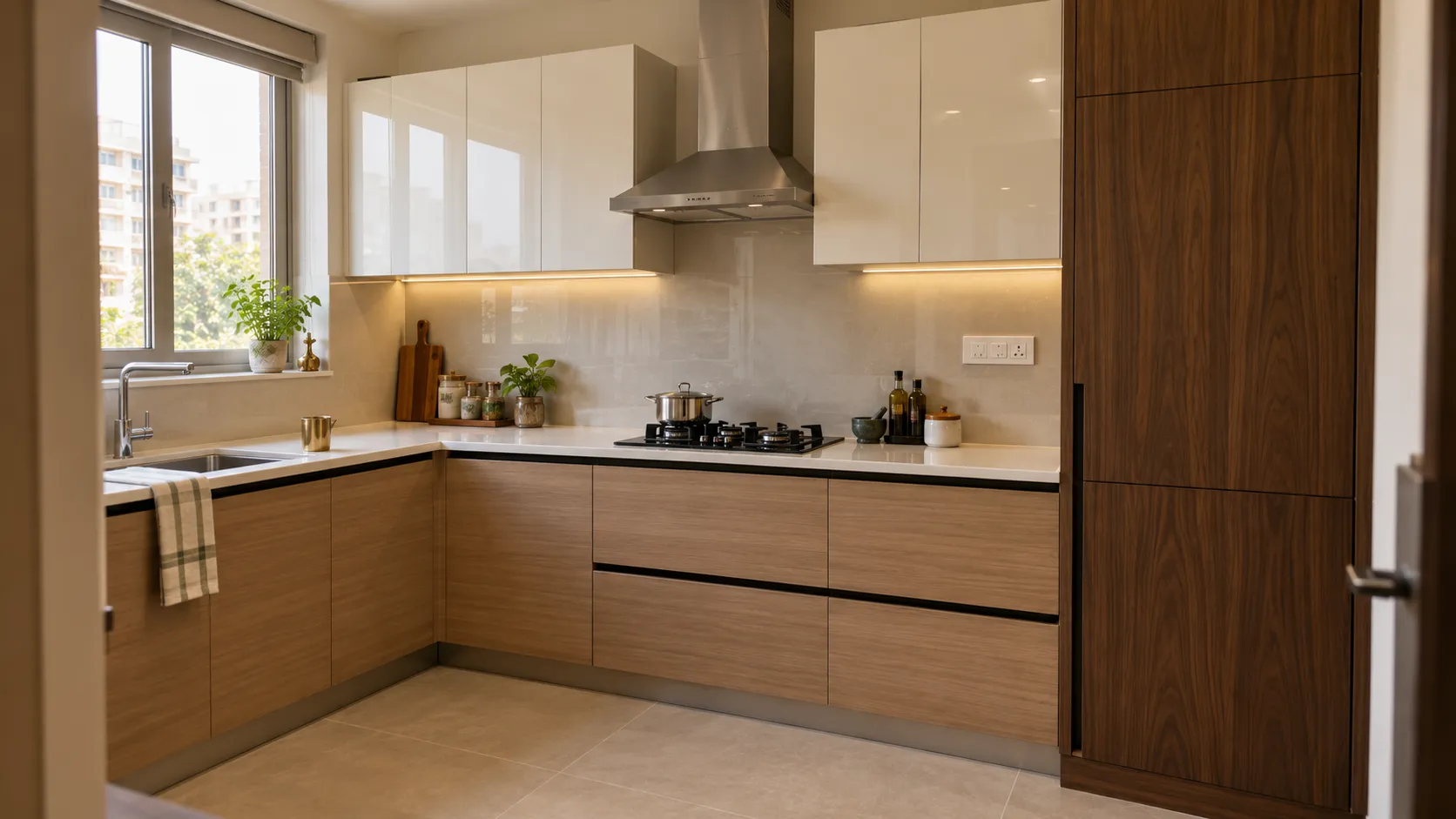
For most kitchens and wardrobes, laminate is the right finish: it is the hardest-wearing, the easiest to live with and the least expensive. Choose acrylic for a glossy front, PU for a seamless painted colour in any shade, and veneer when you want real wood grain. The finish decides how the furniture looks and ages, and it moves the price more than any other single choice.
This guide covers what each finish is, how it wears in a Delhi home, what it costs, where it works best, and what the words “cold press” and “hot press” on a quotation actually mean.
All prices are typical Delhi NCR market rates for supply and installation, before GST. They are a planning guide, not a quotation and not our rate card.
The four finishes at a glance
| Laminate | Acrylic | PU (painted) | Veneer | |
|---|---|---|---|---|
| What it is | 0.8–1 mm decorative sheet glued to the board | 1–1.5 mm acrylic sheet glued to the board | Paint sprayed in many coats onto the board | 0.5–0.6 mm slice of real wood, then polished |
| Looks | Any colour, wood or stone print; matte, suede, gloss, textured | Deep, mirror-like gloss (or a smooth matte) | Seamless colour, matte to high gloss, no joint at the edges | Natural grain; every sheet is different |
| Daily wear | Very good: resists scratches, heat and stains | Good, but gloss shows fingerprints and fine scratches | Good; can chip if knocked hard | Fair: needs care near water and sunlight |
| If damaged | Hard to repair; the panel is usually replaced | Light scratches can be polished out | Can be touched up or resprayed | Can be sanded and re-polished |
| Wardrobe, per sq ft of front | ₹1,200–₹1,800 | ₹1,800–₹2,800 | ₹2,800–₹4,500 | ₹1,800–₹2,800 |
| Best for | Busy kitchens, kids’ rooms, interiors | Modern kitchens, upper cabinets, wardrobes | Handle-less kitchens, colour-led designs | Living rooms, bedrooms, feature walls |
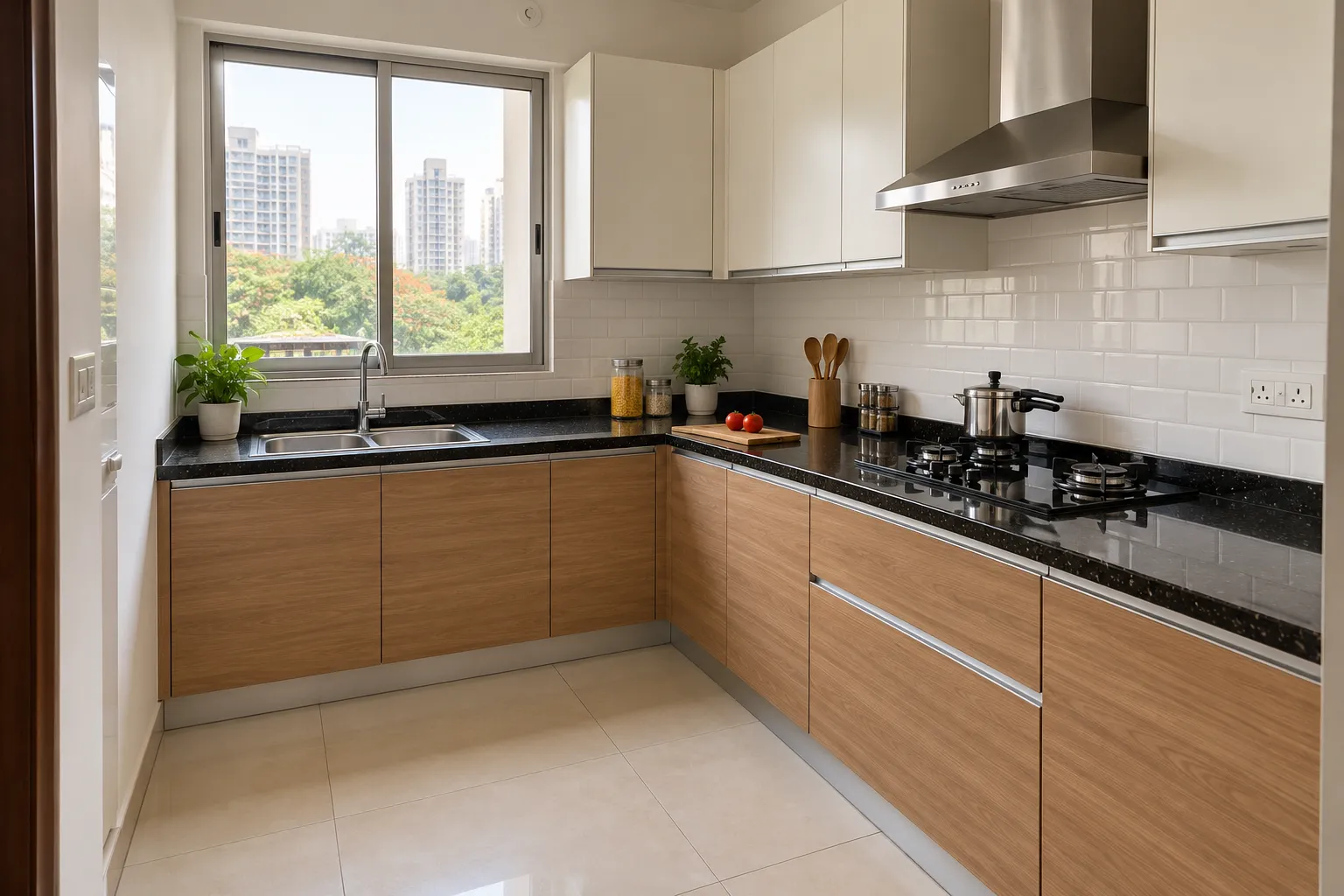
In a modular kitchen the shutter line is usually priced per running foot instead: around ₹5,500 per running foot for laminate, rising to roughly ₹7,000–₹15,000 for acrylic, membrane, PU and lacquered glass. Our guide to reading a modular kitchen quotation shows where that line sits in a full kitchen price.
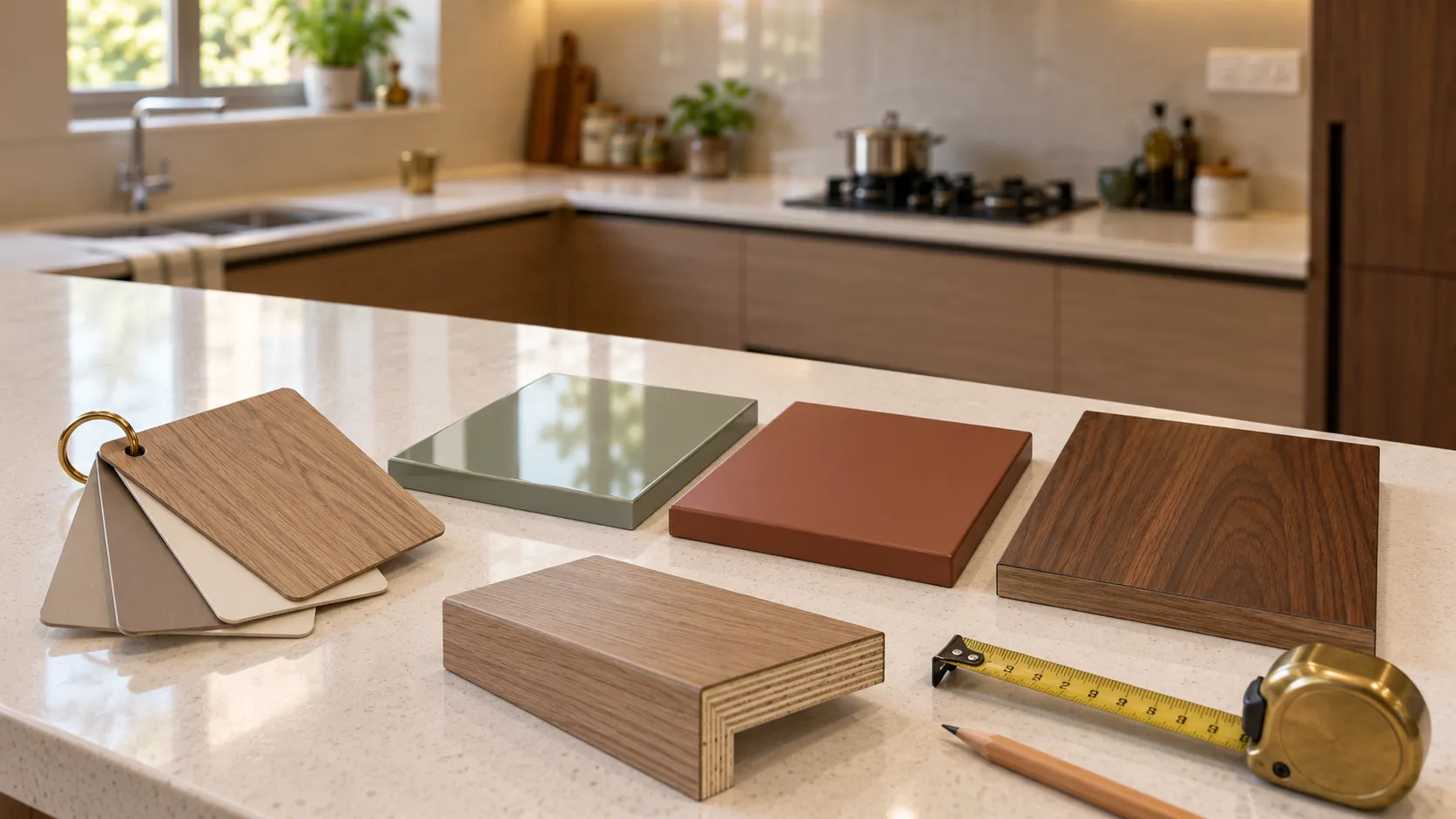
Laminate: the hard-wearing default
Decorative laminate (often called sunmica, after an early brand) is layers of paper and resin pressed into a thin, hard sheet. The top layer carries the colour or print. Brands such as Merino, Greenlam and Century each offer hundreds of shades, wood grains, stone looks and textures.
Why it is the default. It takes knocks, hot pans placed briefly on a shelf, turmeric stains and daily wiping better than any other finish here. It is also the least expensive, so it frees budget for better hardware or a better countertop.
What to watch for:
- Gloss laminate looks smart in the showroom but shows scratches. For a kitchen, choose matte, suede or an anti-fingerprint (AFP) laminate.
- The edges. A laminated panel shows a dark line at its cut edge unless it is sealed with matching edge banding. Good edge banding, applied by machine, is what keeps moisture out. (We run this on our own automatic edge-banding machine.)
- The back face. A shutter laminated on the front only can bow over time. Ask for a balancing laminate on the inside face.
- Thickness. 1 mm on the visible face and 0.8 mm on the back is the norm. A very cheap quote may use thinner sheets.
The inside of cabinets and wardrobes is often pre-laminated board (PLB), which arrives from the board maker already faced. It is perfectly fine for interiors and keeps costs down.
Acrylic: gloss without paint
Acrylic shutters have a 1–1.5 mm acrylic sheet bonded to the board. The result is a deep, glass-like gloss that bounces light around a small kitchen. Matte acrylic exists too, and it is easier to live with.
Strengths: a rich, even colour; good resistance to moisture, because the surface is non-porous; and light scratches can be polished out.
Trade-offs: high-gloss acrylic shows every fingerprint and, in raking light, fine scratches from cleaning cloths. A cheap, unbranded sheet can also fade or yellow over the years where direct sun falls on it.
Acrylic needs a perfectly flat base. A smooth board such as HDHMR or MDF suits it better than plywood, whose grain can show through a gloss face. Our HDHMR vs BWP plywood guide explains the difference.
A popular compromise: acrylic on the upper cabinets, laminate on the base cabinets, where kicks, mops and splashes happen.
PU: a painted finish in any colour
PU (polyurethane) is not a sheet at all. It is paint, sprayed in several coats onto a smooth board, with primer and sanding between coats, then cured. Because it wraps around the edges, there is no joint line and no edge banding to see. That is why handle-less kitchens with routed grip profiles are usually PU.
Strengths: any colour you can name, including a colour matched to your walls; a choice of matte, satin or high gloss; and chips or scratches can be touched up, or a whole shutter resprayed years later.
Trade-offs: it costs the most of the four, and a hard knock can chip it where laminate would shrug it off. Quality depends entirely on the spraying conditions. Dust in the air, too few coats or rushed curing show up as specks, orange-peel texture or soft spots.
That is why PU should be sprayed in an enclosed, dust-controlled booth, not in an open workshop or on site. We spray ours in our own enclosed paint booth, with our own paint team.
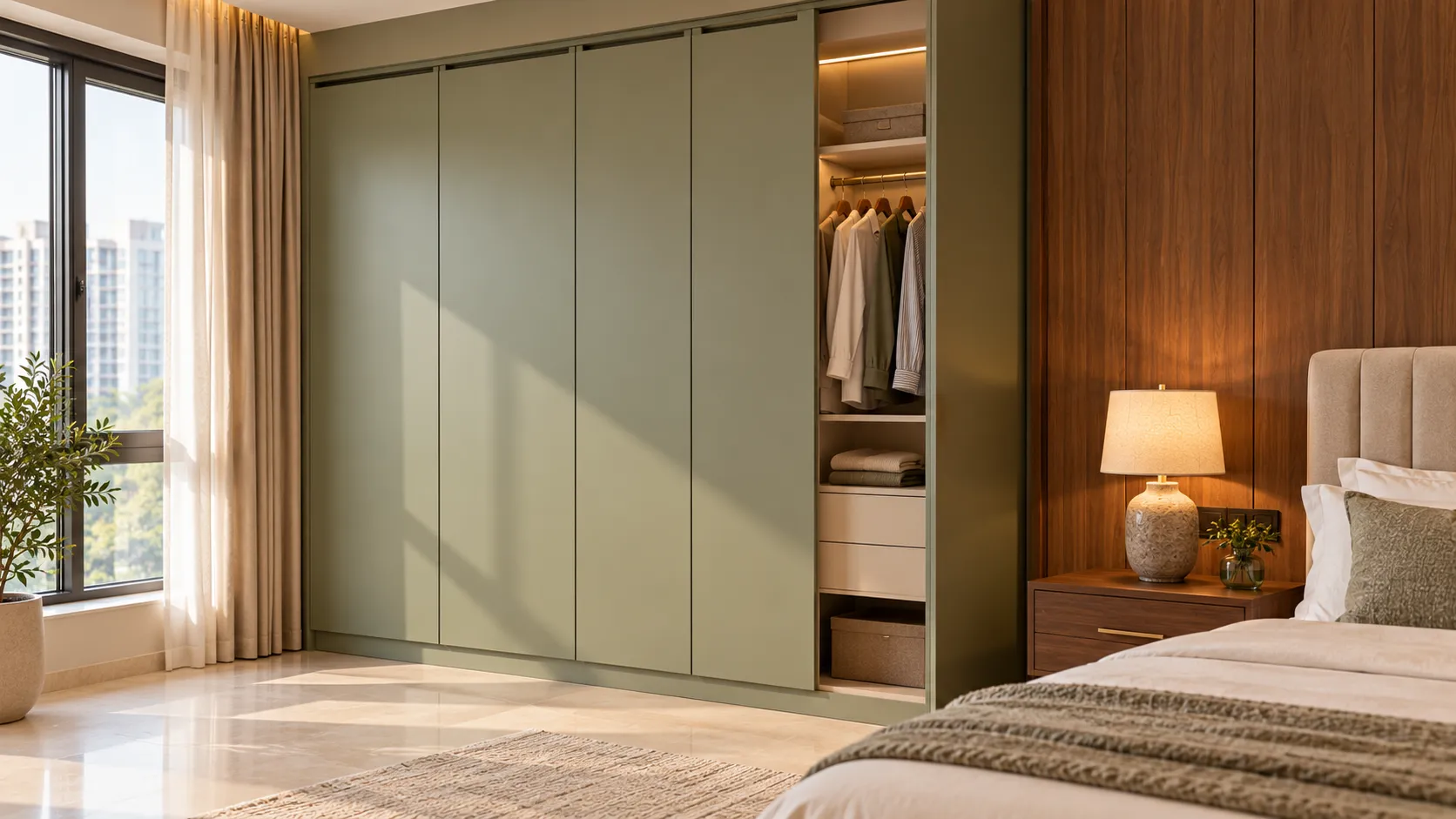
You may also hear “duco”. It is an older word for a painted, lacquered finish. Ask what paint system is actually being used.
Veneer: real wood, with care
Veneer is a thin slice of real wood (teak, walnut, oak, ash and many more) glued to a board and then polished, usually with a PU or melamine polish. It gives you genuine grain, and no two sheets are alike. On a large wall panel, matching the grain across sheets is part of the craft.
Strengths: the warmth of solid wood at a fraction of the price and without the movement of wide solid planks; and it can be sanded and re-polished.
Trade-offs: it needs more care. Standing water at the edges, harsh cleaners and strong direct sun all wear it faster. In a kitchen, keep veneer to the upper cabinets, a breakfast counter or tall units away from the sink and hob.
When comparing quotes, ask for the species, the veneer thickness, the board underneath and the polish (PU or melamine, and matte or gloss). A finish sample on the actual veneer, checked in your room’s light, is worth asking for.
Cold press and hot press: how the finish is stuck on
These two terms often appear on quotations and confuse people. They are not finishes. They describe how a laminate or veneer is glued to the board.
- Hot press: heated plates press the sheet onto the board with a heat-curing glue. The bond forms in minutes, which suits factories pressing large volumes.
- Cold press: a hydraulic press holds even pressure across the whole panel at room temperature for several hours while the glue cures. There is no heat to stress the board or the face, and it is widely used for veneer and for made-to-measure panels.
Both give a strong, lasting bond when the glue is spread evenly and the panel is pressed for long enough. What actually causes bubbles, lifted corners and peeling edges is hand-pressing on site: a carpenter gluing sheets and holding them down with nails, clamps or weights. Pressure is uneven, and air and excess glue get trapped.
So the useful question is not “cold or hot?” but “Is every panel machine-pressed in a workshop, or pasted on site?” We press ours on our own hydraulic cold press, then edge-band them by machine, before anything reaches your home.
Which finish where: a room-by-room guide
- Kitchen base cabinets (sink, hob, dishwasher): matte or anti-fingerprint laminate, or PU, on BWP plywood or HDHMR.
- Kitchen upper cabinets: anything works. This is the place for gloss acrylic or a PU colour if you want one.
- Wardrobe shutters: laminate for value and toughness; acrylic, PU or veneer for a premium look. Inside, use pre-laminated board or laminate.
- Kids’ rooms and study units: textured or anti-fingerprint laminate. It survives stickers, crayons and cleaning.
- Living room panelling, TV walls and bedheads: veneer for warmth, or PU for a calm, single-colour wall. Fluted panels can be either.
- Bathroom vanities: laminate or PU on BWP plywood, with every edge sealed.
Mixing finishes is normal and often the best value. A common pattern is PU or acrylic where you look and laminate where you work.
What to check in a quotation
Before comparing two quotes on price, make sure each one states:
- The finish and its brand and catalogue number, for example the laminate code, so you can see the exact shade.
- The board underneath: BWP plywood, HDHMR or MDF, with its thickness.
- Laminate thickness on the face and whether there is a balancing laminate inside.
- How it is pressed: in a workshop press, or on site.
- Edge banding: thickness (typically 2 mm on shutters), colour match and whether it is applied by machine.
- For PU: the paint system, the number of coats and where it is sprayed.
- For veneer: the species, the thickness and the polish.
- A physical sample of the finish, ideally on the actual board.
A quote that says only “laminate shutters” or “PU finish” leaves room for the cheapest version of each.
Getting the finish right for your home
The finish you see every day is only as good as the board under it and the way it is bonded and sealed. At Eagle Decor, every panel is cut, pressed, edge-banded and, for PU, sprayed in our own factory, so the finish you approve on a sample is the finish you get.
If you are planning a kitchen, use our modular kitchen cost calculator for a first estimate across finishes, or talk to us to see real samples of each finish before you decide.
Frequently asked
Common questions
Which is better for a kitchen, laminate or acrylic? +
For most kitchens, laminate. It shrugs off scratches, heat and cleaning, costs the least and comes in hundreds of colours and textures. Acrylic is the better choice only if you want a glossy, mirror-like front and accept that it shows fingerprints and fine scratches more. Many kitchens use acrylic on the upper cabinets and laminate below.
Is PU finish better than laminate? +
Not better, different. PU is sprayed paint, so it gives a seamless colour in any shade with no visible joint at the edges, and scratches can be touched up. Laminate is harder-wearing day to day and costs roughly half as much. PU suits handle-less, colour-led designs; laminate suits busy family kitchens and kids' rooms.
What is the difference between cold press and hot press lamination? +
They are two ways of gluing a laminate or veneer to the board, not two kinds of finish. A hot press uses heated plates and bonds in minutes; a cold press uses even hydraulic pressure at room temperature and is held for several hours while the glue cures. Both give a lasting bond when done properly. What causes bubbles and lifting is hand-pressing on site with nails and weights.
Is veneer suitable for kitchens? +
It can work on upper cabinets, a breakfast counter or a tall unit away from the sink, sealed with a good PU polish. On the base cabinets beside the sink and hob, laminate, acrylic or PU on HDHMR or BWP plywood hold up better, because water at the edges and daily wiping wear veneer faster.
How much do different finishes cost per sq ft for wardrobes? +
At typical Delhi NCR market rates for supply and installation, before GST: about ₹1,200–₹1,800 per sq ft of front area in laminate, ₹1,800–₹2,800 in acrylic or veneer, and ₹2,800–₹4,500 in PU lacquer, glass or fluted shutters.