
How to Read a Modular Kitchen Quotation, Line by Line
Two quotes for the same kitchen can be lakhs apart. Here is what each line of a modular kitchen quotation actually buys, typical Delhi NCR rates per running foot, and what quotes quietly leave out.
8 October 2026
Two quotations for the same kitchen can be ₹1.8 lakh apart, and most of the time neither studio is cheating. They are pricing two different kitchens that happen to share a floor plan: different board inside the cabinets, different hinges, a granite top in one and quartz in the other, and a different idea of what “included” means.
A modular kitchen quotation is easy to compare once you know what each line is actually buying. This guide walks through a typical Delhi NCR quote line by line, explains the numbers we see in the market, and lists the questions worth asking before you sign anything.
Start with the unit: running foot, square foot or module
Before comparing totals, check how each quote is measured. Studios in Gurugram and Delhi use three methods, and they produce very different-looking numbers for the same kitchen.
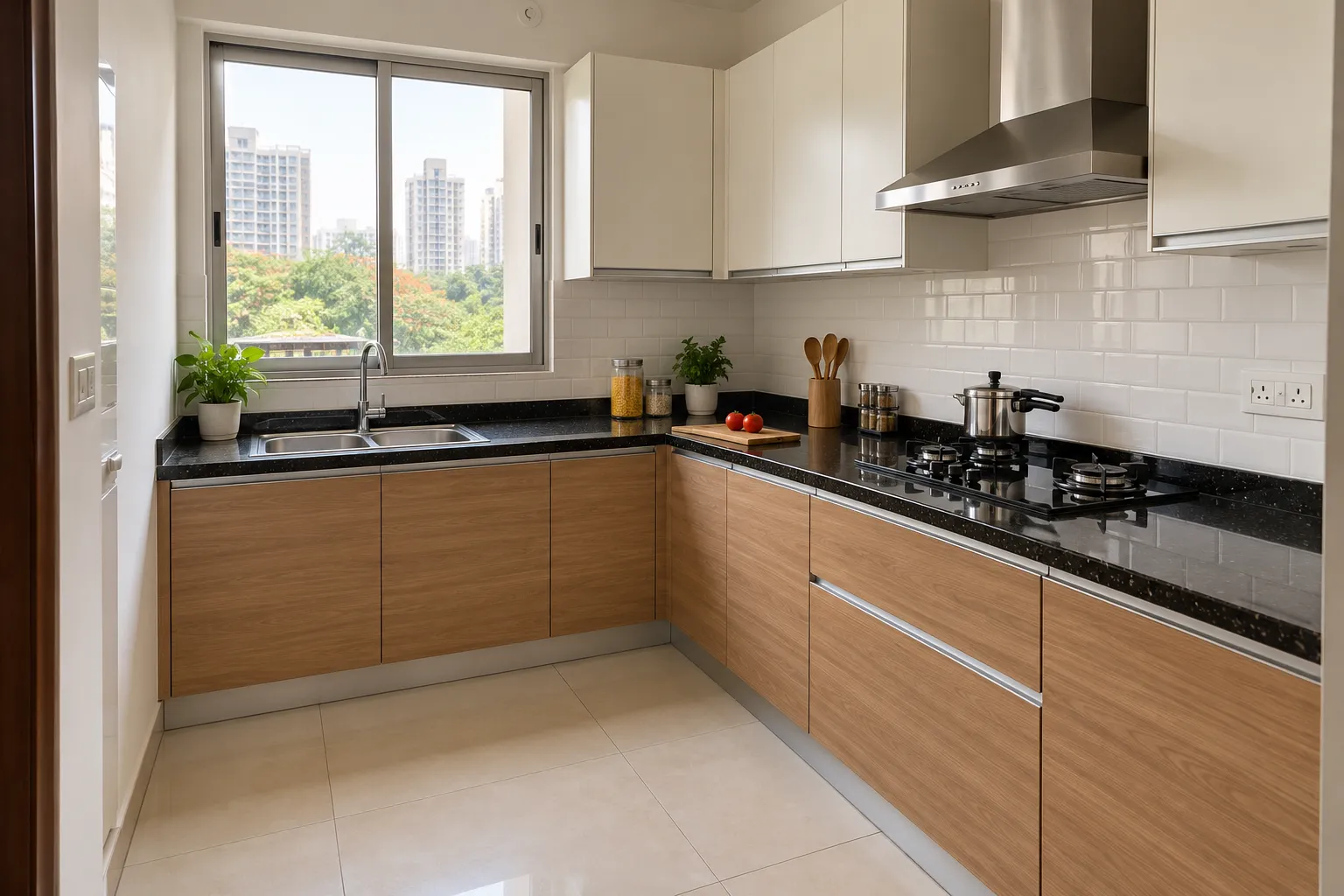
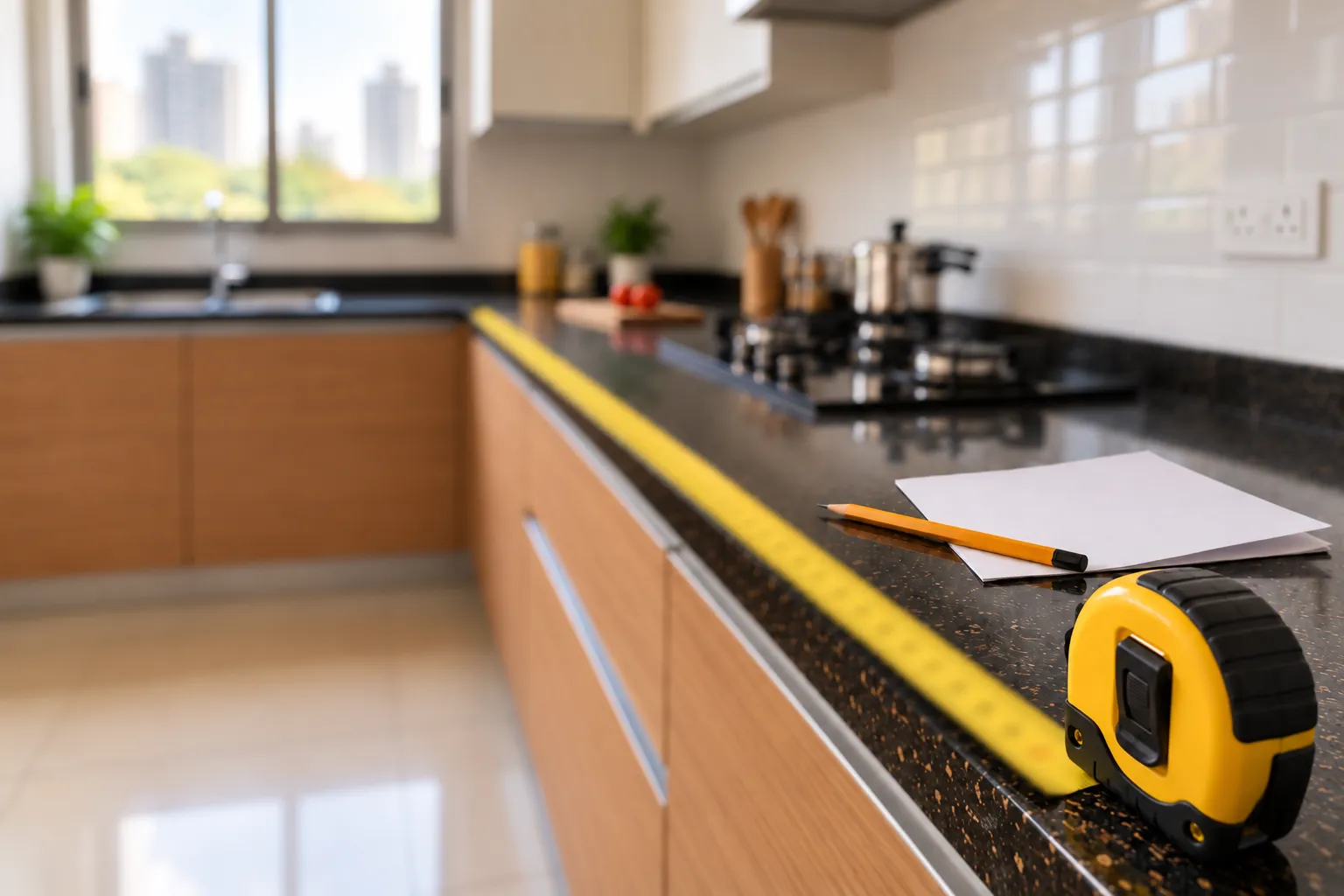
- Per running foot (rft). One running foot is one linear foot of wall carrying cabinets, measured along the countertop. A 10 ft L-shaped kitchen in a 2BHK is typically 10–12 rft. Base and wall units are usually priced together in this single rate, which makes it the easiest method to compare.
- Per square foot. The rate looks much smaller, but what counts as a square foot varies. Some studios measure only the shutter fronts, others add the carcass surfaces too. Ask how the area was calculated, or the per-sq-ft rate tells you very little.
- Per module or unit. Each cabinet is priced separately: a 900 mm sink unit, a 600 mm drawer unit and so on. It is the most transparent method, but the hardest to compare quickly.
If one quote is per running foot and the other per square foot, ask the second studio for the running-foot length of the kitchen and convert before you decide anything. Most “this one is so much cheaper” moments disappear at this step.
Line 1: the carcass, the box you never see
The carcass is the cabinet box behind the shutters, and it decides how long the kitchen lasts, especially around the sink. A quote that just says “plywood” is not a specification. Look for three things:
- Material and grade. BWP (boiling-water-proof) plywood made to IS:710 marine grade, or HDHMR board, are the two sensible choices for a Delhi NCR kitchen. MR-grade plywood and particle board cost less but swell if water gets in, which it eventually does under a sink.
- Thickness. Side panels and shelves should be 18 mm (some studios use 16 mm for wall units). Back panels are usually 6 mm or 8 mm; anything thinner is worth questioning.
- Brand. A named board brand on the quote is something you can check on delivery. “Equivalent” is not.
For reference, market rates for the carcass alone run roughly ₹6,000 per running foot for particle board, ₹9,500 for BWP plywood and ₹11,000 for HDHMR, with base and wall units combined. If you are unsure which board to choose, our HDHMR vs BWP comparison goes through the trade-offs in detail.
Line 2: shutters and edge banding
Shutters are what you look at every day, so finish usually gets most of the attention. Laminate is the hard-wearing default at around ₹5,500 per running foot. Membrane, acrylic, PU and lacquered glass climb from roughly ₹7,000 to ₹15,000.
Two details on this line matter more than the finish name:
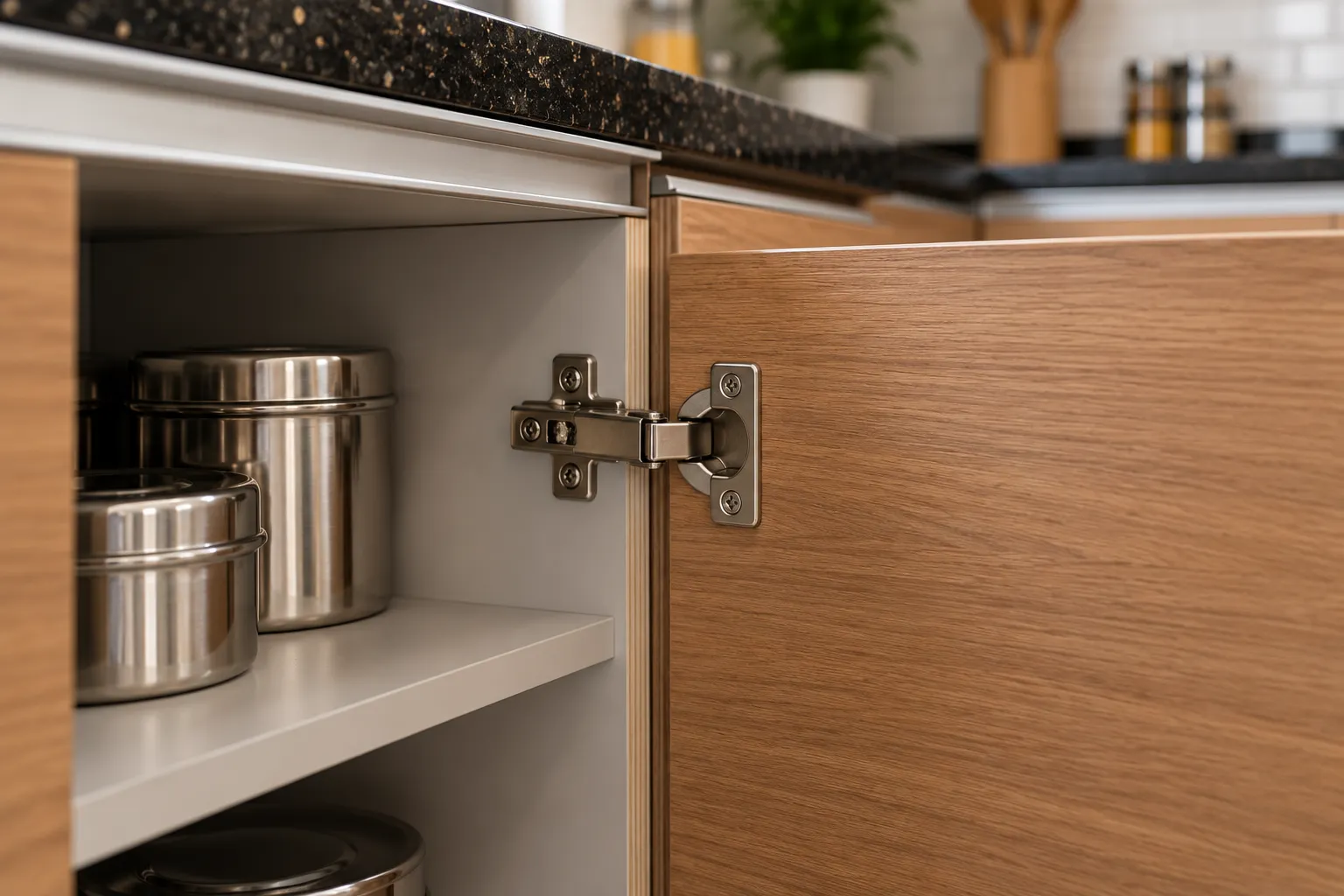
- Edge banding. Every cut edge of every panel needs sealing. A good quote states the thickness (typically 2 mm on shutters and 0.8 mm on internal carcass edges) and whether it is applied by an automatic edge-bander. Hand-glued edge strips are where peeling and moisture damage usually start. (This is the step we run on our own automatic edge banding machine.)
- The inside face. A shutter laminated on the outside only can bow over time. Ask whether the inner face carries a balancing laminate.
Line 3: hardware, where quotes differ the most
On paper, hardware is a single line. In practice it is often the biggest gap between two quotes, because “soft-close hardware” can mean a ₹150 hinge or a ₹900 one.
Ask for a hardware schedule that lists, for every item, the brand, the model and the quantity:
- Hinges. How many, soft-close or not, and the opening angle. Corner and tall units need different hinges from standard doors.
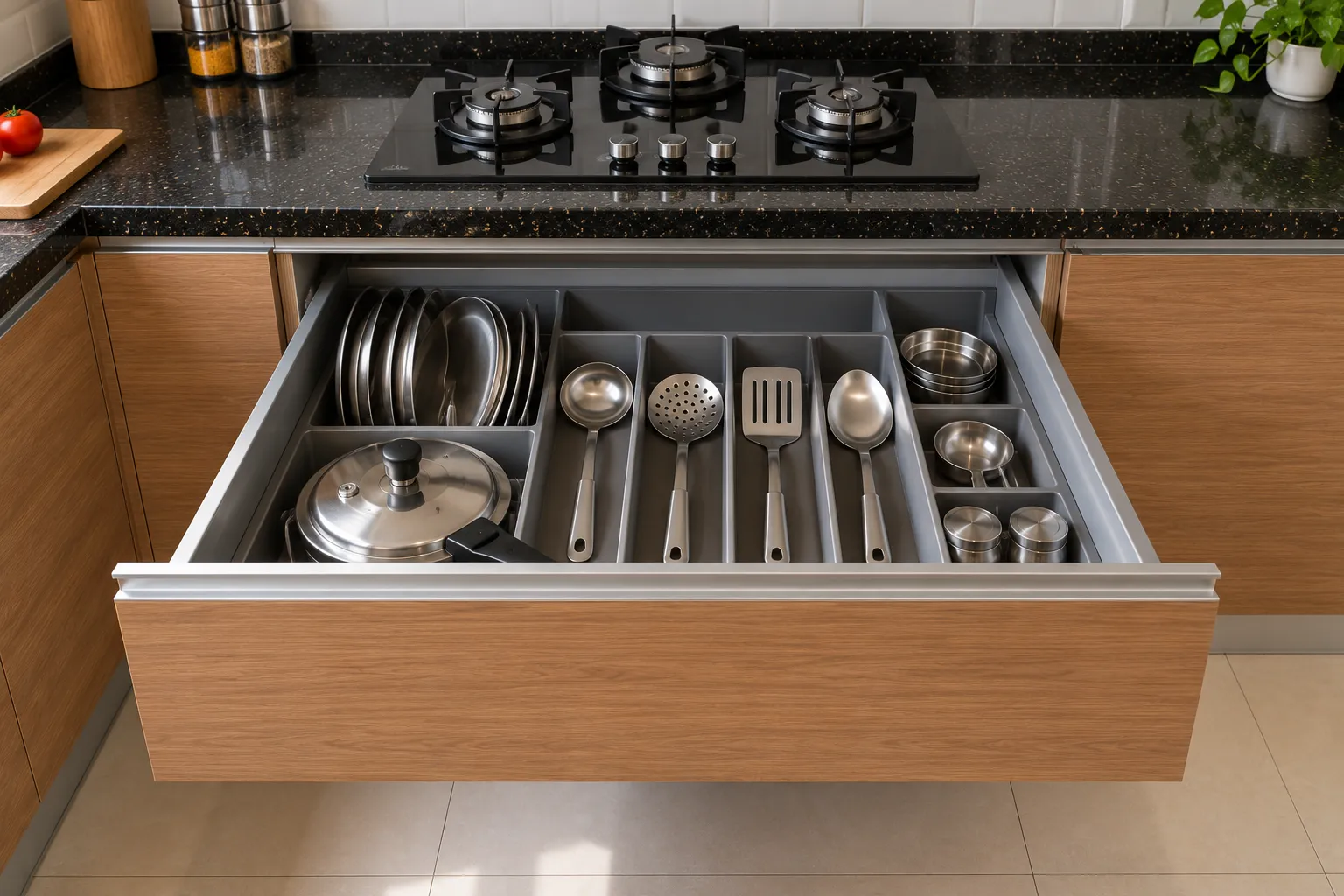
- Drawer channels. Telescopic channels are the budget option; full-extension drawer systems with metal sides (often called tandem boxes) cost more and carry far more weight. A kitchen with five or six drawers can swing the total by ₹30,000 or more on this item alone.
- Baskets and accessories. Stainless-steel baskets should be SS 304, which resists rust much better than the cheaper 202 grade. Corner carousels, tall pull-out larders, cutlery organisers and integrated bins all belong on the list by name.
- Lift-up and tall-unit mechanisms, if your design has them.
As a rough guide, the market range runs from about ₹3,000 per running foot for basic hinges and channels, to ₹7,000 for soft-close throughout with cutlery and bottle pull-outs, to ₹14,000 or more for full drawer systems, lift-ups and corner solutions.
Line 4: the countertop
Countertops are often quoted per square foot of stone, not per running foot of kitchen, so check which. Granite is the economical, durable choice at roughly ₹3,500 per running foot of kitchen; engineered quartz is around double that, with a consistent pattern and a non-porous surface.
Then check what the stone line includes:
- the edge profile (a plain straight edge is standard; bullnose or mitred edges cost extra);
- sink and hob cut-outs, which some fabricators charge separately;
- joints and seams, and where they will fall on an L-shaped top;
- whether the backsplash (stone or tile) is in this line or a separate one.
What the number usually leaves out
This is where two “similar” quotes quietly part ways. Go through the list below and mark each item as included, excluded or not mentioned. Anything not mentioned is a question to ask.
- Appliances: chimney, hob, built-in oven, microwave, dishwasher. A typical appliance package adds roughly ₹80,000 to ₹2,50,000.
- Sink and tap, plus the waste coupling and fittings.
- Backsplash tiling and any civil work on walls or floors.
- Electrical and plumbing changes: new points for the chimney, hob, RO and microwave, or moving the sink.
- Chimney ducting to the outside wall.
- Lofts above the wall cabinets, and skirting (the plinth along the floor).
- Transport, installation and site cleaning.
- GST. Check whether the total is inclusive or exclusive. On modular furniture it is usually charged at 18%, which is not a small line.
A worked example, using market rates
Here is how a common mid-range kitchen adds up: a 10 running-foot L-shaped kitchen with a BWP plywood carcass, laminate shutters, standard soft-close hardware and a granite top:
- Carcass, BWP plywood: ₹9,500 per rft
- Shutters, laminate: ₹5,500 per rft
- Hardware, standard soft-close: ₹7,000 per rft
- Countertop, granite: ₹3,500 per rft
- Total: ₹25,500 per running foot × 10 rft = ₹2,55,000
- L-shaped layouts need extra corner joinery and hardware, usually about 5% more: ₹2,67,750
Before site measurement, an honest estimate for this kitchen sits somewhere between about ₹2.35 lakh and ₹3 lakh, before appliances, the sink, tiling and GST. You can run your own size and materials through our modular kitchen cost calculator to see where your quotes fall.
Questions to ask before you sign
- Can I see drawings with internal dimensions? Elevations should show every cabinet, its width and what goes inside it.
- What exactly is the board, the shutter and the hardware? Brand, grade and model, in writing, not “equivalent”.
- What is the warranty, and on what? Carcass, shutters and hardware are often covered for different periods. Ask for it on paper.
- How are payments staged? A common pattern is an advance on design sign-off, a second payment before production and the balance after installation. Be wary of paying most of the amount upfront.
- What is the timeline, and what must be ready on site first? Tiling, electrical points and plumbing usually need to be finished before cabinets are installed.
- What happens if the final site measurement differs from the estimate? Ask how changes are priced, before they come up.
Why the factory behind the quote matters
Two quotes with identical line items can still deliver very different kitchens, because a specification is only as good as the cutting, edging and fitting behind it. A studio that manufactures its own cabinets controls those steps: panels sized on a beam saw, edges sealed on an automatic edge-bander, finishes sprayed in an enclosed paint booth. If you are comparing a factory-made kitchen with one assembled by a carpenter on site, ask where the cabinets will actually be made, and by whom. (You can see how our own manufacturing works.)
A good quotation is one you can read back line by line and understand what you are paying for. If any line on yours is vague, that is the line to question.
Frequently asked
Common questions
Is a modular kitchen measured in square feet or running feet? +
Both are used, and they give very different-looking rates. Most Delhi NCR studios quote per running foot (one linear foot of wall with cabinets, base and wall units together); some quote per square foot of shutter or carcass area, and some price each module. To compare two quotes, convert both to running feet first.
What is a running foot in a modular kitchen quotation? +
One running foot is one linear foot of wall carrying cabinets, measured along the countertop. Base and wall units are usually priced together in the running-foot rate, so a 10 ft L-shaped kitchen is quoted as roughly 10 running feet.
Why are two modular kitchen quotes for the same kitchen so different? +
Usually because they specify different kitchens: a different board grade inside the cabinets, different hinges and drawer systems, granite versus quartz, or a different list of what is included. Compare them line by line, in the same unit, before comparing totals.
Is BWP plywood or HDHMR better for a kitchen carcass? +
Both are sound choices for Delhi NCR. BWP plywood to IS:710 handles water best and is the safer pick around the sink; HDHMR is denser and gives a smoother base for shutters. Many kitchens use BWP for base units and HDHMR for shutters.
Does a modular kitchen quotation include appliances and GST? +
Often not. Appliances, the sink and tap, backsplash tiling, electrical and plumbing changes and GST are frequently excluded or listed separately. Ask the studio to mark each one as included or excluded.
How much does a 10 ft L-shaped modular kitchen cost in Gurugram? +
At typical market rates, a 10 running-foot L-shaped kitchen with BWP plywood, laminate shutters, soft-close hardware and a granite top comes to roughly ₹2.35–3 lakh before appliances, sink, tiling and GST.