
HDHMR vs BWP Plywood: Modular Kitchens in Delhi NCR
Choosing between HDHMR and BWP plywood determines your kitchen's lifespan against Delhi NCR's humidity. Learn which core material offers the best moisture resistance and finish.
20 July 2026
Choosing the right carcass material—HDHMR vs BWP plywood—dictates the longevity and finish quality of any modular kitchen built for Delhi NCR’s shifting climate. At Eagle Decor, our Gurugram-based interior design studio frequently guides homeowners through this exact decision, balancing extreme moisture resistance against flawless exterior finishes. The foundation of your cabinetry is just as important as the visible surfaces, especially in regions that experience severe dry heat followed by heavy monsoon humidity.
Whether you are renovating an apartment in Noida or building a sprawling villa in South Delhi, understanding the structural differences between these two leading materials will help you make an informed investment.
Understanding the Core Materials for Your Kitchen
Before deciding on the aesthetics of your space, you must select the structural core of your cabinets. The two most prominent contenders in the premium market are HDHMR and BWP Marine Plywood.
HDHMR stands for High-Density High Moisture Resistance. It is an engineered board made by combining hardwood fibers with specialized water-resistant resins, pressed together under extreme heat and pressure. The result is a dense, uniform board without any internal gaps.
BWP, or Boiling Water Proof Plywood (often referred to as Marine Grade Plywood), is constructed by bonding multiple layers of wood veneers together with waterproof synthetic resins. The cross-grained layering technique gives plywood its renowned structural strength and prevents warping under heavy loads.
HDHMR: The Champion of Seamless Finishes
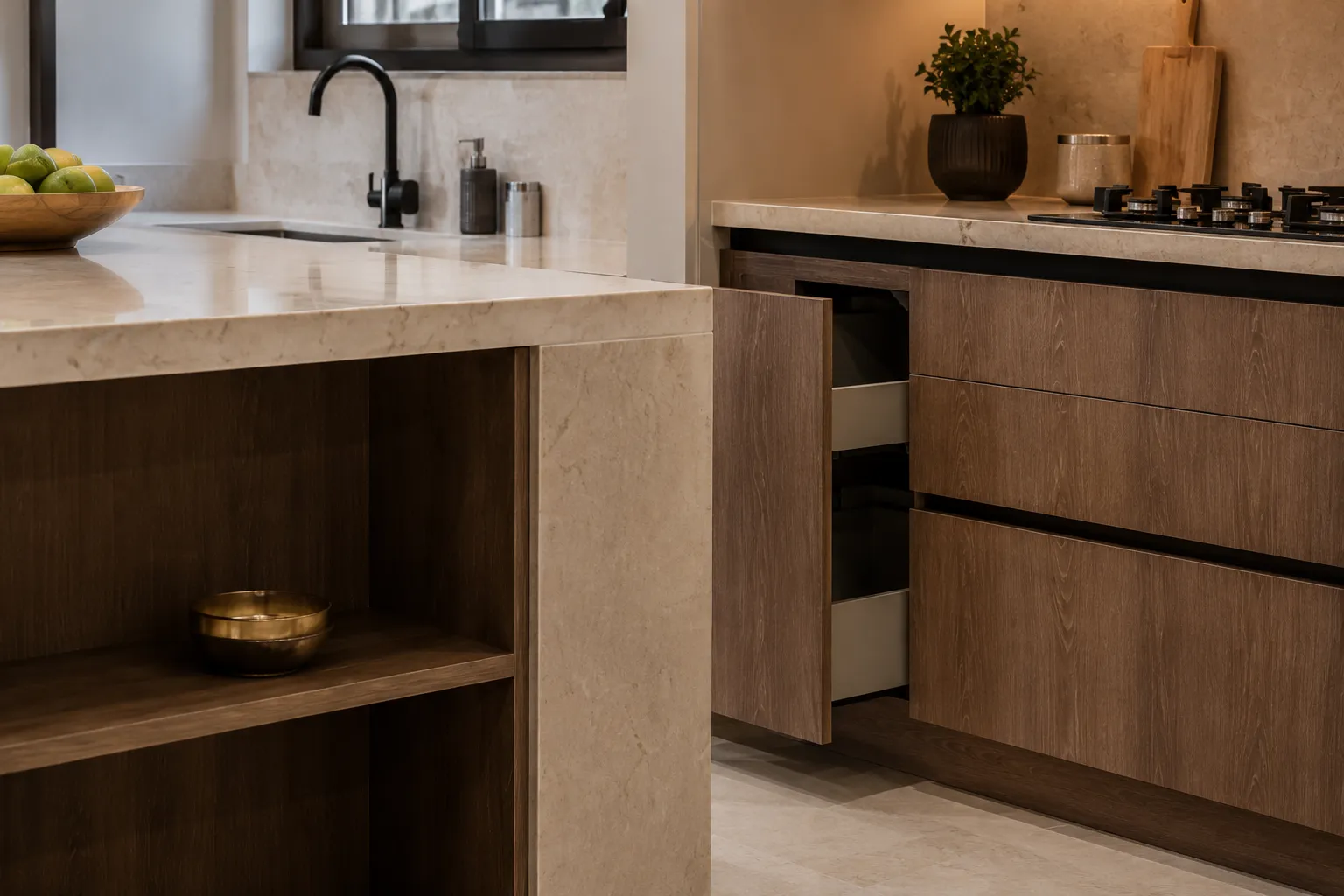
The most significant advantage of HDHMR is its incredibly smooth surface. Because it is manufactured from compressed fibers rather than layered veneers, it lacks the natural grain variations and minor surface imperfections found in standard plywood.
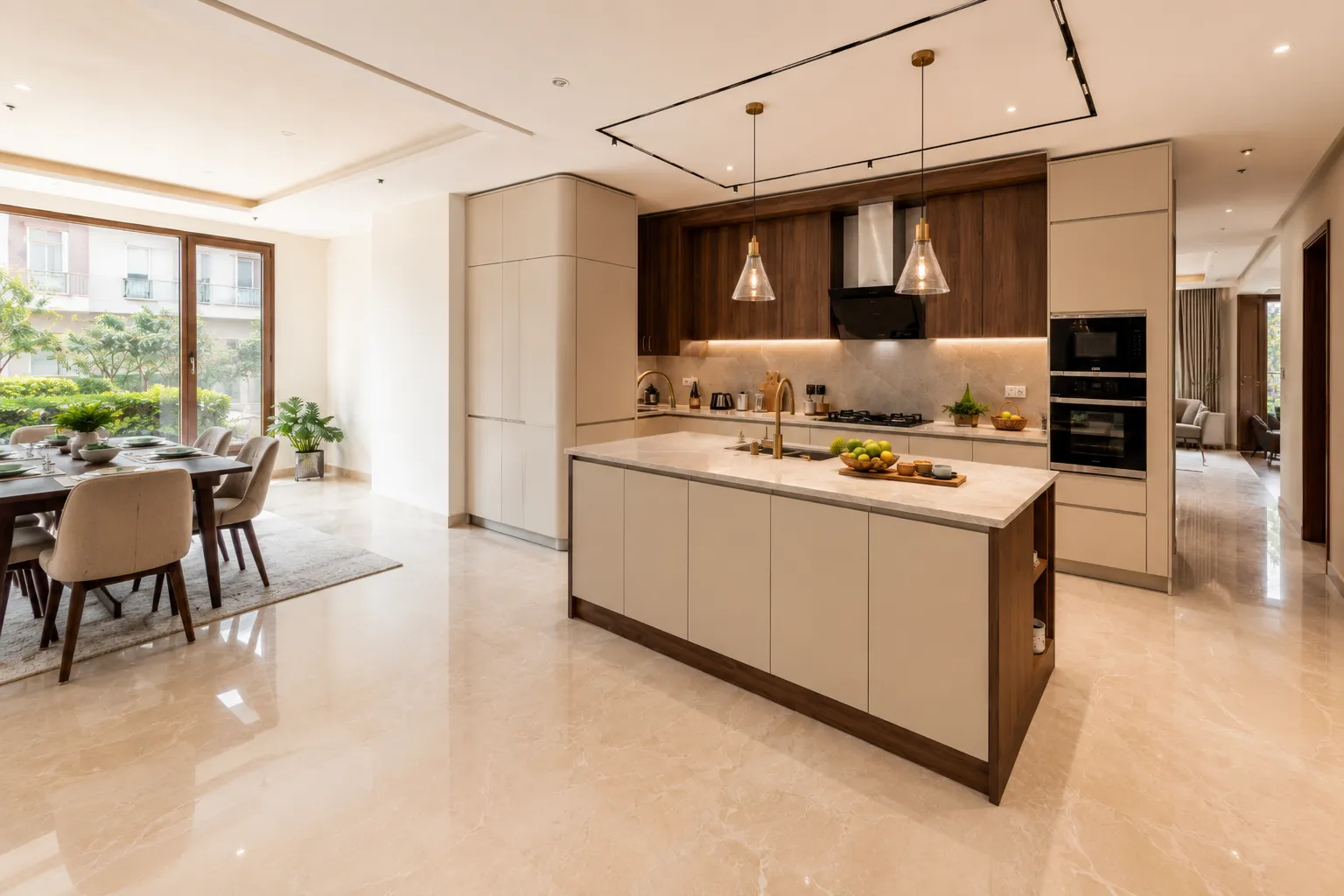
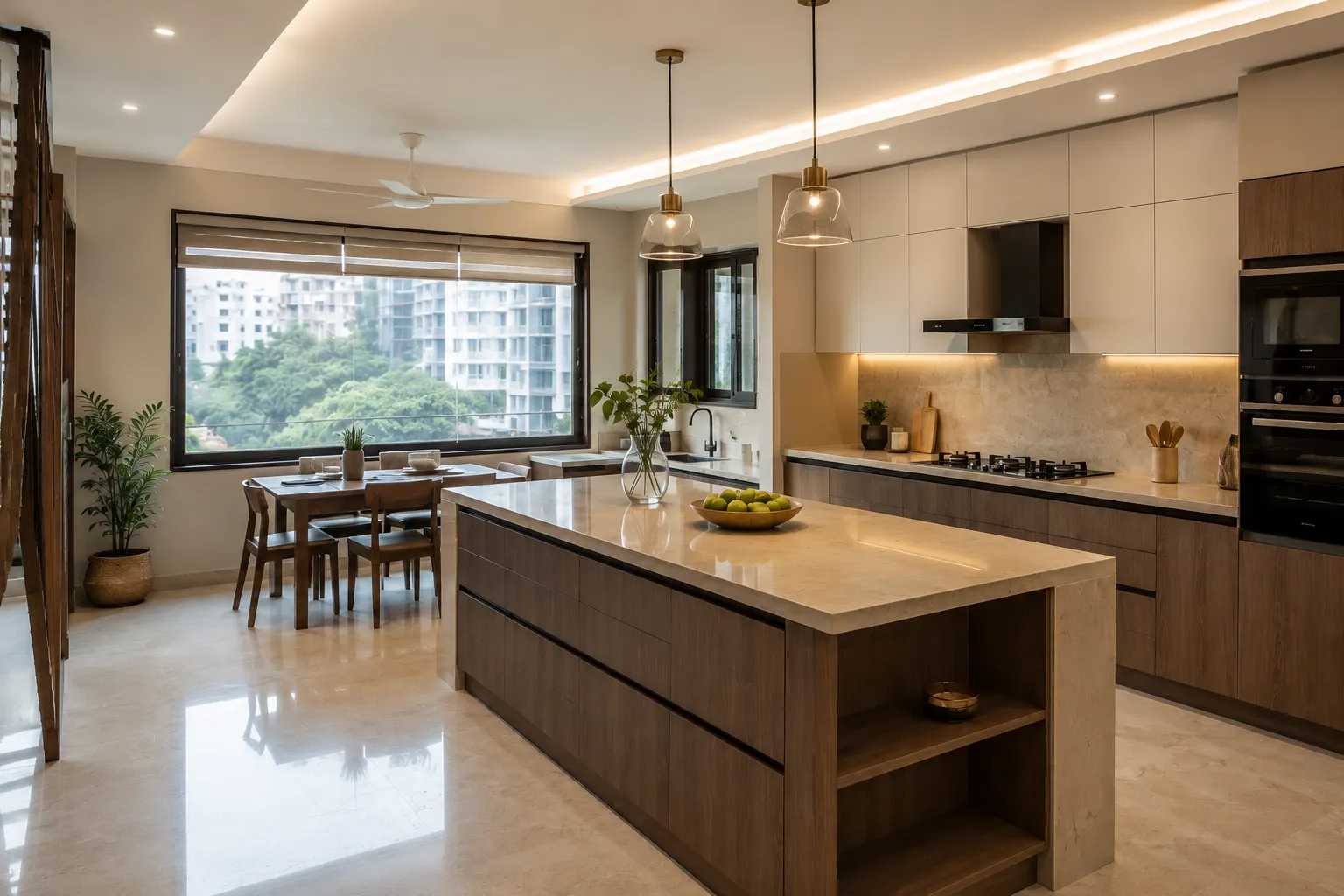
For modern, minimalist kitchens featuring handle-less designs or integrated profile handles, HDHMR is highly recommended for the cabinet shutters (doors). It provides the perfect substrate for high-gloss acrylics, premium laminates, and pristine PU paint finishes. In contemporary designs, such as the sleek beige upper cabinets and deep wood-grain lower cabinets seen in modern layouts, HDHMR ensures the surface remains perfectly flat without any rippling effect over time.
Additionally, HDHMR routes beautifully. If your design calls for intricate grooves, shaker-style doors, or precise edge banding, the dense core allows for sharp, clean cuts. The interior drawers also benefit from this density, offering clean, smooth internal walls that are easy to wipe down and maintain.
BWP Plywood: Maximum Moisture Resistance
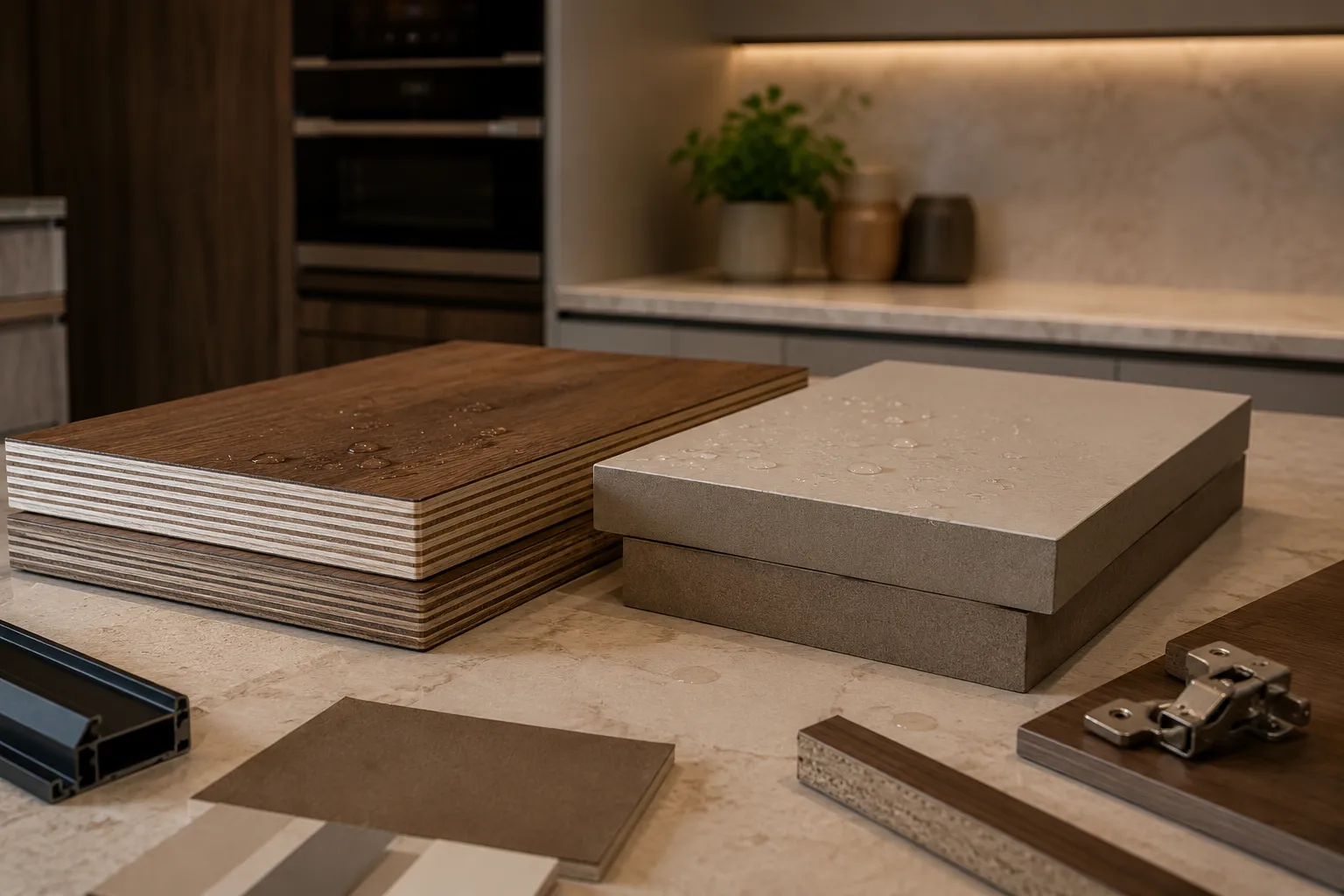
While HDHMR is highly moisture-resistant, BWP Marine Plywood remains the undisputed champion of enduring direct, prolonged water exposure. The specialized phenolic resins used to bind the cross-banded veneer layers prevent water from penetrating the core, making it virtually impervious to rot and fungal attacks.
In a bustling Indian kitchen, the sink unit and the areas immediately surrounding the dishwasher or wet utility zones are prone to frequent splashes and potential plumbing leaks. BWP plywood is specifically engineered to withstand these harsh conditions without swelling or delaminating.
When examining the raw materials side-by-side, the structural differences are visually apparent. Plywood features distinct horizontal lines representing each layer of wood veneer, whereas HDHMR presents as a solid, uniform block. Both materials can be treated to resist water droplets, but the layered strength of BWP plywood provides superior screw-holding capacity, which is crucial for heavy, load-bearing lower cabinets and heavily utilized hinges.
HDHMR vs BWP Plywood: A Direct Comparison
To make the best choice for your home, it helps to evaluate these materials across a few key performance metrics:
Structural Strength and Load Bearing
Because of its cross-layered construction, BWP plywood has a higher tensile strength. It is less likely to sag over long spans, making it ideal for the main structural carcass of your lower cabinets and wide shelving units.
Screw Holding Capacity
Kitchen cabinets endure constant opening and closing. The hinges and drawer channels carry significant weight. BWP plywood grips screws tightly between its natural wood grains. HDHMR also has good screw-holding capacity due to its high density, but plywood generally performs slightly better for heavy-duty, repetitive stress over decades.
Cost Effectiveness
Genuine BWP Marine Plywood is a premium material and commands a higher price point due to the quality of the wood veneers and specialized resins used. HDHMR offers an excellent, cost-effective alternative that provides near-comparable moisture resistance at a more accessible price, allowing homeowners to allocate more of their budget to luxury finishes and high-end appliances.
The Hybrid Approach for Delhi NCR Kitchens
Given the specific climatic challenges of Gurugram, Delhi, and Noida, the most effective strategy is rarely a strict “either/or” choice. Instead, we advocate for a hybrid approach that maximizes the strengths of both materials.
For complete turnkey solutions for interior and exterior spaces by Eagle Decor, we frequently specify BWP plywood for the lower base cabinets, especially the sink unit and any cabinetry touching the floor where mopping moisture might seep up. This ensures the structural integrity of the kitchen remains uncompromised against water.
Conversely, we utilize HDHMR for all the cabinet shutters, drawer fronts, and upper wall cabinets. This guarantees a flawless, premium finish for the visible exterior while keeping the overall project weight manageable and cost-effective.
By understanding how these materials perform under stress and humidity, you can create a culinary space that is both structurally sound and visually breathtaking. If you are ready to build a kitchen that lasts a lifetime, explore our custom cabinetry options and premium handmade furniture in Delhi, Gurugram & Noida by Eagle Decor.
Frequently asked
Common questions
Can I use HDHMR for the kitchen sink unit? +
While HDHMR is highly moisture-resistant, we generally recommend BWP Marine Plywood for the sink unit and areas with direct, continuous water exposure to ensure maximum longevity against potential leaks.
Does HDHMR provide a smoother finish than BWP plywood? +
Yes. Because HDHMR lacks the alternating grain layers found in plywood, its surface is completely uniform. This makes it the superior choice for high-gloss acrylic, PU paint, and seamless laminate finishes.
Which material is more cost-effective for a modular kitchen? +
HDHMR is typically more cost-effective than genuine BWP Marine Plywood. Many homeowners opt for a hybrid approach—using BWP for wet zones and HDHMR for dry zones and cabinet shutters—to balance budget and performance.
Which material holds screws better for heavy cabinet doors? +
BWP plywood generally has a superior screw-holding capacity due to its cross-layered natural wood grains, making it highly durable for heavy-duty hinges, though high-density HDHMR also performs very well for standard doors.